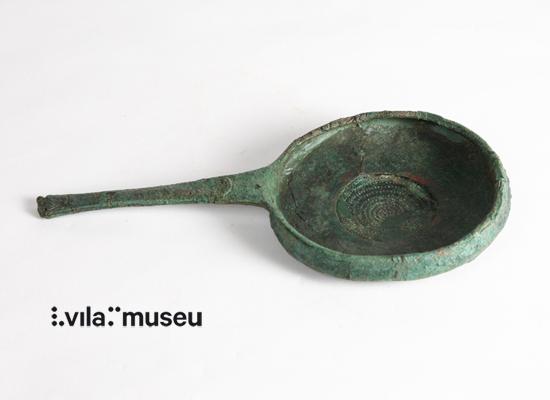
Etruscan bronze colander
Etruscan bronze strainer. It features a shallow central bowl, the inner base of which is meticulously perforated in concentric circles, and a rectangular-section handle, the upper part of which is entirely decorated with dotted lines. Two decorative motifs can be distinguished: one in the shape of an ivy leaf at the end of the handle, and a second teardrop-shaped motif next to the bowl. The handle of this piece is incomplete, as it is fragmented at the end, where the beginnings of two circular appendages can be seen, which formed part of a ring for suspending the piece. This extraordinary piece was found alongside two other pieces of Attic pottery, a gold ring with spiral decoration and a Hispanic ring fibula, forming part of the grave goods of an adult female.
This type of strainer was used in Etruria and Greece at funeral banquets to filter wine from the amphora into the krater and from there into the various cups or jugs at the banquets.
The presence of an Etruscan piece in Vilajoiosa tells us of a direct relationship with Greek merchants. This tomb is also part of a group of female tombs, something characteristic of Greek culture. Some indications, such as these, rekindle the debate on whether there were Greek colonies in the south of Ampurias and Rosas, as suggested by ancient sources, which mention Alonís, the Greek name of the city of Àlon (Vilajoiosa), created by the Phoenicians in the VII century BC.
Necropolis of Poble Nou, Doctor Fleming road sector, tomb 32
Height: 30 mm; Length: 280 mm; diam.: 145 mm;
Orientalizing or Ancient Iberian period (6th century BC)
Inv. Vilamuseu: 003370